
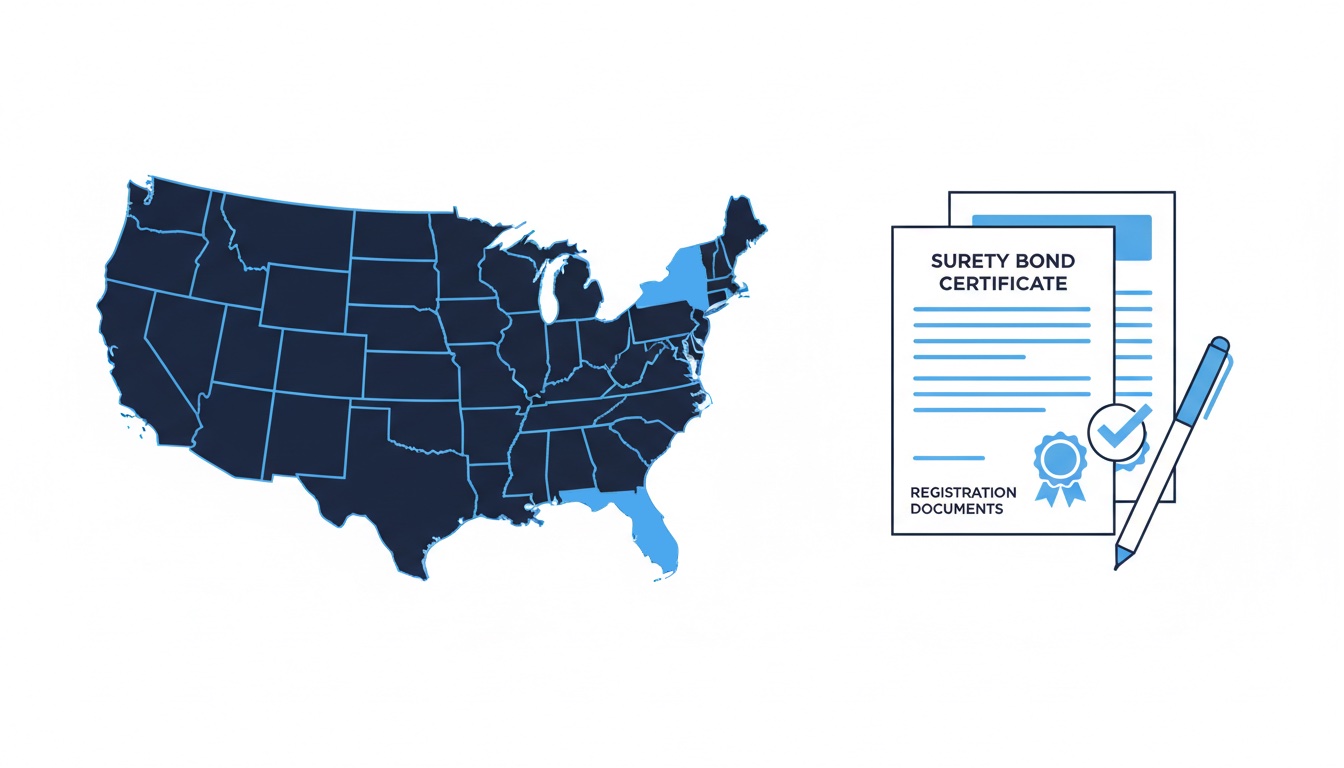
For an ordinary free commercial sweepstakes, check prize-value filing requirements before announcing the campaign. Florida, New York and Rhode Island have distinct regimes; their statutory scope, thresholds and timing are not interchangeable.
This guide focuses on covered chance promotions. Free judged photo/video competitions are not automatically subject to the same filing rules, and public voting should not automatically be classified as pure skill. Paid entries, purchase-linked participation and regulated industries require their own analysis. This is an informational overview, not advice for a particular campaign.
National context: Cohen Silverman Rowan's promotions overview and Fasthoff Law Firm's filing overview identify these three states. The primary sources below govern the specific requirements; the summaries are not an exemption from other states' disclosure or conduct rules.
Compare filing requirements
| State | Covered prize value | Timing | Fee | Security |
|---|---|---|---|---|
| Florida | More than $5,000 | At least 7 days before launch | $100 | Full-value trust or bond; qualifying waiver may apply |
| New York | More than $5,000 | At least 30 days before launch | $100 | Trust/CD or surety bond under state instructions |
| Rhode Island | More than $500 for covered retail promotions | Address filing before launch; confirm applicability | $150 | No bond specified in the cited retail filing law |
Read the state-specific explanations before applying the table. A prize-value threshold alone does not establish whether an unusual sponsor, prize or selection mechanism falls within the law.
New York: plan for the advance filing
GBL §369-e covers specified consumer-product or service promotions awarding prizes by chance without consideration. The Department of State filing includes rules, prize information and other contest details. Arrange the required trust/CD or surety security using the official instructions.
New York also requires a post-promotion statement within 90 days after completion covering winners of prizes worth more than $25, the prizes and delivery dates. Keep the required records. Do not replace that report with a generic financial statement or assume a registration number must appear in every advertisement without a supporting rule.
Sources: GBL §369-e; Department of State filing instructions. Read the New York guide.
Florida: full-value security, with alternatives
Florida §849.094 concerns defined game promotions connected with consumer products or services and involving chance and a prize. Covered promotions need rules and prize information filed before launch. The statute provides a full-value trust account or surety bond, with a discretionary waiver for qualifying operators.
There is no $100,000 security cap. A covered promotion offering $500,000 in prizes cannot assume only $100,000 needs to be secured. Filed rules cannot then be changed, and winners of prizes over $25 must be reported within 60 days after final determination using the statutory procedure. Keep winning entries for 90 days after completion.
Sources: Florida §849.094; FDACS guidance. Read the Florida guide.
Rhode Island: resolve scope before assuming exemption
Rhode Island §11-50-1 concerns chance promotions offered by a retail establishment to promote its retail business. The filing describes the prizes, winning opportunities, rules, period and geographic area.
Department of State form 660 uses broader language for games offered to Rhode Island residents, including games offered from outside the state. Do not assume an online-only promotion is exempt based solely on its entry channel. Resolve applicability with the Department of State or campaign counsel before launch. The cited statute and form do not specify a fixed seven- or thirty-day advance deadline.
The statutory recordkeeping period is six months after completion; agency instructions call for a winners list kept for at least one year. Plan for the longer instruction. The retail filing law does not specify a bond.
Sources: Rhode Island filing statute; recordkeeping statute; form 660 instructions. Read the Rhode Island guide.
What about the other states?
These three filing regimes do not constitute a nationwide approval. States such as Oregon, Maryland and Connecticut impose meaningful disclosure or conduct requirements within their own definitions and exceptions. Other industries and promotion formats may involve additional permits.
Arizona's purchase-linked amusement-gambling intellectual-contest provision is not a filing requirement merely because a free photo/video submission contest uses judging or public voting. Apply the law to the actual mechanics. Use the state-law directory and Arizona explanation to keep those distinctions clear.
A practical filing plan
- Finalize the prize pool, eligible states and winner-selection method.
- Identify the applicable filing and security rules before choosing the launch date.
- Prepare consistent rules, advertisements and entry settings, then submit the prescribed materials.
- Keep filing and security records; registration is not a substitute for lawful administration.
- Track winner verification, prize delivery, reports and retention deadlines.
For free-entry design, advertising and tax reporting, see the national sweepstakes guide.